ENIGMA LOGICFROM COMPLEXITY TO CLARITY

SERVICES

Four ways we work
with your business.

Each engagement starts with understanding the system, not with a predefined tool.

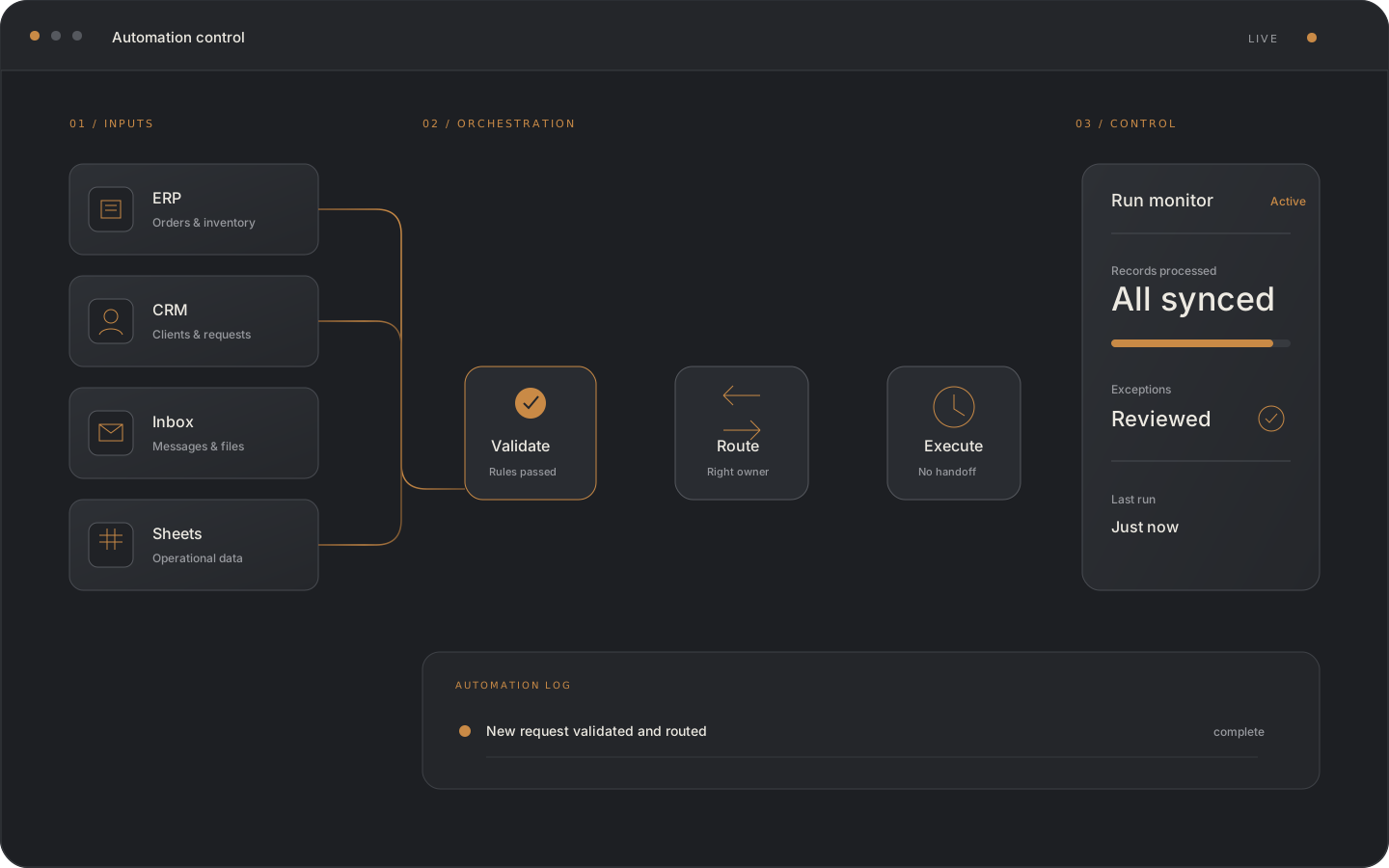
Dashboard mockup of an automation pipeline validating, routing, and executing requests

SYSTEMS BEFORE SOFTWARE

01 / 04
01

Custom Software Solutions

We design and build software around how your business actually works - not around a generic template. Every feature is tied to a specific decision, process or information gap we verified first.

WHO IT IS FOR

Companies that have outgrown notebooks and spreadsheets, but for which an off-the-shelf ERP is too large, too expensive and full of things they will never use.

WHAT YOU GET

  • A map of the process before a line of code is written - showing both what we are solving and what we are deliberately leaving alone.
  • A working version your people use in the job, not a demo on a projector.
  • Source code, database and every access credential in your company's name, from day one.
  • Documentation of how the system starts, restores and changes - enough for somebody else to take it over tomorrow.

HOW LONG IT TAKES

A first usable module in four to eight weeks. A full system takes longer, and always in parts that stand on their own.

WHEN THIS IS THE WRONG CALL

If an existing product already covers most of your job, we will say so and turn the work down. Buying it is cheaper for you.

What a plan that holds looks like
02

Business Process Automation

We automate work that is repetitive, error-prone or dependent on manual coordination - after confirming that automation is the right answer, not just the one that was asked for.

WHO IT IS FOR

Companies where the same job is done by hand every month, for two days, and everyone in the building knows it.

WHAT YOU GET

  • A list of the repeating jobs, with an estimate of the hours each one costs per year.
  • Automation of what pays for itself, and the reasoning for everything we deliberately left to a person.
  • A check that the automation holds when the data is messy, because it always is.
  • An alert when something did not go through, so silence does not get mistaken for success.

HOW LONG IT TAKES

One process: two to four weeks, from measurement to running in production.

WHEN THIS IS THE WRONG CALL

If the process is not stable, automation only makes the same mistake faster. The process gets fixed first; the automation comes after.

Where the warehouse gap comes from
03

Systems Analysis & Consulting

We investigate a specific problem - operational, informational or organisational - and deliver a clear picture of the system, the evidence and the options, before any commitment to build.

WHO IT IS FOR

When you know something is wrong but not what exactly, and you do not want to pay for a solution before you know the problem.

WHAT YOU GET

  • A map of how the work actually flows today, built from conversations with the people who do it.
  • The places where time and money leak, ranked by what they cost per year.
  • Options with a cost and a risk for each, including the option of doing nothing.
  • A written findings document that is yours to keep, whether or not we work together afterwards.

HOW LONG IT TAKES

Two to three weeks for one process or department. The first conversation and the assessment are free.

WHEN THIS IS THE WRONG CALL

If the decision is already made and only needs endorsing, we are the wrong choice. Analysis sometimes concludes that the planned project should not happen.

An example of the same reasoning, on scheduling
04

Maintaining & Taking Over Existing Systems

We take on systems we did not build and act as your external IT team under an SLA: database optimisation, data recovery, archiving and disaster recovery policy. You do not need to hire an IT person for the system to run reliably. support@enigmalogic.io

WHO IT IS FOR

Companies whose system works, whose business depends on it, and which nobody has touched since the last developer left.

WHAT YOU GET

  • An inventory of where the system runs, who holds which access and what happens if it disappears - in the first week.
  • Ownership of the domain, hosting and accounts moved back into your company's name.
  • An SLA with a stated response time, without hiring anyone in house.
  • A tested restore, with the time it took written down. A backup you have never restored is not a backup.

HOW LONG IT TAKES

Inventory and handover of access: the first week. Maintenance runs monthly, and can be ended without penalty.

WHEN THIS IS THE WRONG CALL

If the system needs replacing rather than patching, we will say that too - together with an estimate of what replacing it costs and how long it takes.

Guide: taking over a system with no developer

PRICING

What it costs, and when that is known.

Analysis, consultation and the proposal are free. Always, and with no obligation to work with us afterwards.

Build work is a fixed price for the scope the analysis defined. A fixed price is possible precisely because by then it is known what is being built - without the analysis, any figure would be a guess, ours as much as yours.

Maintenance is billed monthly under an SLA with a stated response time. It can be ended without penalty, with a notice period that leaves you time to find a replacement.

Small changes and advice are billed by the hour, from a block of hours agreed in advance.

If the scope moves during the work, that is visible and agreed before it is billed. No invoice arrives as a surprise at the end.

THE FIRST TWO WEEKS

What happens before the first invoice.

01

Conversation

Forty-five minutes, with nothing to prepare on your side. You describe what is going wrong, we ask. By the end we both know whether we can help at all.

02

Looking at the system

We follow how the work flows, talk to the people doing it and look for numbers. This is usually where it turns out the problem is not where it was assumed to be.

03

Findings

A written document: what we found, what it costs per year and what the options are. That document is yours and stays with you whatever you decide.

04

Decision

If it makes sense, you get a proposal with a fixed price and a date. If it does not, we say so plainly. Up to this point you have paid nothing.

COMMON QUESTIONS

What people ask before they call.

Do you work with companies that already have software?
Yes. We take on systems we did not build, including ones with no documentation and no original developer. Repairing what exists is often cheaper and faster than building new, and we will tell you when that is the case.
What if the developer who built our system no longer works with us?
Control comes back first: domain, hosting, accounts and a copy of the data in your company's name. The code comes after that. We wrote a whole guide on it, because the situation is far more common than people think.
Do we have to change how we work?
We start from the assumption that you do not. If a step turns out to need changing, we will explain why and what it buys you, and the decision is yours. A system that forces a company to adapt to it tends not to stay in use.
Who owns the code?
You do. Source code, database and access credentials are in your company's name and that is written into the contract. We do not build dependency on ourselves - if you decide one day to work with somebody else, you should be able to, without negotiating with us.
Do you work with small companies?
Yes, and that is often where the effect is largest. For a company of ten people, one automated report can free up a day a month. If the job is too small to pay for itself, we will tell you that too.
What if we do not need software, just advice?
Then it is service 03, and it starts the same way - with a free analysis. Sometimes the conclusion is that no software is needed, only a change to one step in the process. That is a valid result, not a failure.

START WITH THE PROBLEM

Tell us the problem.
We'll start with questions.

Tell us the problem↗